Not sure which cabinets fit your kitchen remodel? This guide breaks down styles, materials, and the real differences between custom and stock options.
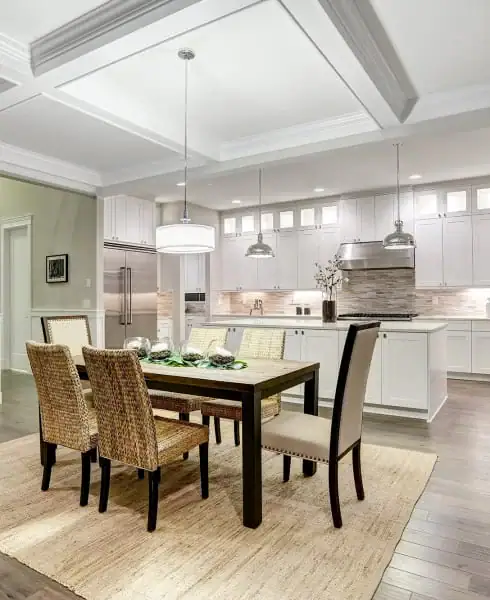
Before you start looking at door styles or finishes, you need to understand the three main categories of kitchen cabinets. Each one offers different levels of flexibility, quality, and cost—and the right choice depends on your kitchen’s layout, your budget, and how much customization you actually need.
Stock cabinets are pre-manufactured in standard sizes and sold ready to install. You’ll find them at home improvement stores and some cabinet retailers, usually available the same day or within a week. They come in limited sizes (typically 3-inch increments), standard depths, and a smaller selection of door styles and finishes. The trade-off for convenience and lower cost is that you’re working with what’s available, not what’s ideal for your space.
Semi-custom cabinets bridge the gap between affordability and personalization. They’re built to order with more size options, a wider range of door styles and finishes, and the ability to add features like pull-out shelves or specialized storage. You’ll wait longer than stock—usually four to eight weeks—but you gain flexibility to adapt cabinets to your kitchen’s specific needs without the premium price of full custom work.
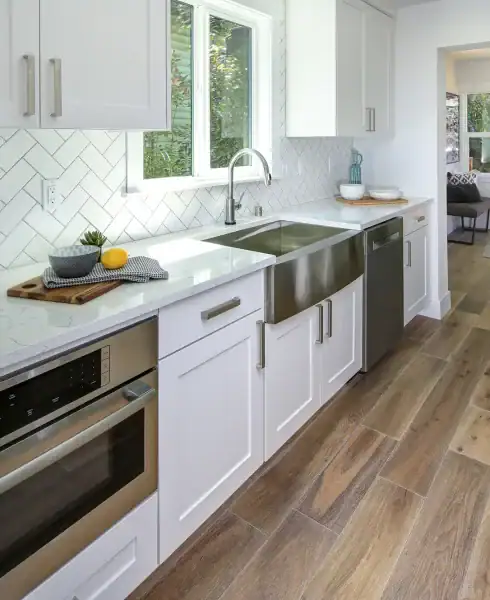
Custom cabinets are built specifically for your kitchen, down to the exact millimeter. If your kitchen has unusual dimensions, awkward corners, ceiling heights that don’t match standard cabinet sizes, or you want complete control over every detail, custom cabinetry solves problems that stock and semi-custom options can’t address. This is especially common in older homes throughout Wake County and Horry County where original layouts don’t conform to modern standard measurements.
You’ll work with a designer to specify everything: the exact dimensions, the type of wood, the construction method, the finish, the hardware, the interior configuration. Want a cabinet that’s 27.5 inches wide instead of 27 or 30? Need extra-deep drawers for your oversized pots? Custom work accommodates those requests without compromise.
The quality tends to be higher across the board. Custom cabinet makers typically use solid hardwood or furniture-grade plywood, dovetail joints, full-extension drawer glides, and multi-step finishing processes that create durable, long-lasting surfaces. You’re paying for materials, craftsmanship, and the flexibility to get exactly what you want.
Expect to invest $500 to $1,200 per linear foot for custom cabinets, and plan for a timeline of 8 to 12 weeks or longer from design to installation. For a standard 10×10 kitchen, that translates to $10,000 to $24,000 just for the cabinets. That’s a significant investment, but if you’re dealing with a challenging layout, plan to stay in your home long-term, or want a truly one-of-a-kind kitchen, custom work delivers results that other options can’t match.
The downsides are obvious: cost and time. You’ll also need to make a lot of decisions, which can feel overwhelming if you’re not sure what you want. But for homeowners who value precision, quality, and a perfect fit, custom cabinets are worth the investment.
Most kitchen remodels fall somewhere between stock and semi-custom. These options give you a functional, attractive kitchen without the extended timeline or premium cost of full custom work—as long as you understand what you’re getting and where compromises might show up.
Stock cabinets cost $100 to $400 per linear foot installed, making them the most budget-friendly choice. You’ll find them made from melamine, laminate, or basic plywood with veneer finishes. Construction quality varies widely depending on the manufacturer, so it’s worth examining how boxes are assembled, whether shelves are adjustable, and what kind of drawer glides are used. Some stock cabinets use particle board, which doesn’t hold up well to moisture or heavy use—a real concern in coastal areas of Horry County where humidity levels stay high year-round.
The real limitation with stock cabinets is fit. If your kitchen has standard dimensions and you’re willing to use filler strips to bridge gaps, stock cabinets work fine. But if your space has odd measurements, low ceilings, or unusual configurations, you’ll end up with wasted space or awkward proportions.
Semi-custom cabinets address many of those issues. You’ll pay $200 to $650 per linear foot installed, but you gain flexibility in sizing (often down to 1-inch increments), a much wider selection of door styles and finishes, and the ability to add features like soft-close hinges, pull-out trash bins, or specialized corner solutions. The materials tend to be higher quality—solid wood doors, plywood boxes, better hardware—and the overall construction is more durable than entry-level stock options.
For most homeowners, semi-custom cabinets hit the sweet spot. You get enough customization to make the kitchen work well for your specific needs, better materials and construction than stock, and a price point that doesn’t require a second mortgage. The four-to-eight-week lead time is manageable if you plan ahead, and the end result looks and functions like a much more expensive kitchen.
Want live answers?
Connect with a American Dream Floor expert for fast, friendly support.
The material your cabinets are made from determines how long they last, how well they resist moisture and daily wear, and whether they’ll still look good in 15 years. This isn’t just about aesthetics—it’s about whether your investment holds up or becomes a source of frustration and repair costs down the road.
Solid hardwood remains the gold standard for cabinet doors and face frames. Maple, oak, cherry, and birch are popular choices because they’re strong, durable, and can be stained or painted to achieve almost any look. Hardwood resists dents and scratches better than engineered materials, and if damage does occur, it’s often easier to repair. The trade-off is cost and the fact that natural wood expands and contracts slightly with changes in humidity and temperature—something to consider if you live near the coast where moisture levels fluctuate with the seasons.
Plywood is the most reliable choice for cabinet boxes. It’s made from thin layers of wood veneer glued together with alternating grain directions, which creates exceptional strength and resistance to warping. Unlike solid wood, plywood stays stable in humid environments, making it ideal for kitchens in both inland Wake County and coastal South Carolina. Quality plywood cabinets last 15 to 30 years with minimal maintenance.
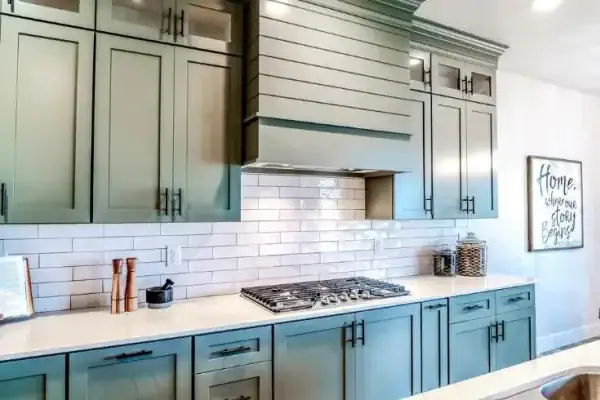
Medium-density fiberboard (MDF) has become common in cabinet construction, especially for painted doors and drawer fronts. It’s made from wood fibers and resin compressed into smooth, dense panels that take paint beautifully without showing wood grain. MDF costs less than solid wood and provides a uniform surface that’s ideal for modern, painted finishes.
The challenge with MDF is moisture. Standard MDF swells and deteriorates when exposed to water, so it’s not suitable for areas near sinks or dishwashers unless it’s properly sealed. Moisture-resistant MDF addresses this issue with special additives and better edge sealing, making it a viable option for kitchens. Even so, MDF is heavier than plywood and won’t hold screws as securely over time, which can affect hinge performance on heavy doors.
Particle board sits at the bottom of the durability scale. It’s made from wood particles and adhesive pressed into sheets—lighter and cheaper than other options but also weaker and more susceptible to moisture damage. You’ll find particle board in budget stock cabinets, often covered with laminate or melamine to protect the surface. It can work for short-term solutions or rental properties, but it’s not a material that will last decades in a busy family kitchen.
If you’re considering cabinets with MDF or particle board, ask about the core material, how edges are sealed, and what warranty the manufacturer offers. A moisture-resistant MDF cabinet with proper edge banding and a durable finish can perform well for 10 to 15 years. A particle board cabinet with thin laminate and exposed edges will start showing its age much sooner.
The finish on your cabinets matters just as much as the material underneath. High-quality finishes involve multiple steps: sanding, priming, several coats of paint or stain, and a protective topcoat. Catalyzed lacquer and conversion varnish create hard, chemical-resistant surfaces that handle kitchen grease, steam, and cleaning products without yellowing or deteriorating. Cheaper finishes chip, peel, or fade within a few years, especially on high-use areas like drawer fronts and doors near the stove.
The style of your cabinet doors sets the tone for your entire kitchen. It’s one of the first things people notice, and it influences whether your space feels traditional, modern, or somewhere in between. But door style isn’t just about appearance—it also affects how easy cabinets are to clean, how visible the cabinet frame is, and even how much storage space you can access.
Shaker cabinets remain the most popular choice for good reason. They feature a simple five-piece door with a flat center panel surrounded by a frame, creating clean lines that work in almost any kitchen style. Shaker doors look at home in farmhouse kitchens, transitional spaces, and even modern designs depending on the finish and hardware you choose. The straightforward design is easy to clean and doesn’t go out of style. In 2026, slim shaker and micro-shaker variations are gaining momentum—these use thinner rails and stiles for a more refined, contemporary look while keeping the classic shaker profile.
Slab doors offer the ultimate in minimalist design. They’re flat, frameless panels with no raised details or decorative elements. Slab doors create a sleek, modern aesthetic and work especially well in contemporary kitchens with handleless cabinets or integrated pulls. They’re also the easiest to clean since there are no grooves or details where dust and grease can accumulate. The trade-off is that every imperfection shows—fingerprints, smudges, and surface variations are more visible on flat surfaces than on detailed doors.
Inset doors sit flush with the cabinet frame when closed, creating a furniture-quality look with tight reveals between doors and drawers. This style requires precise construction and high-quality hardware, which is why it’s typically found in custom and high-end semi-custom cabinets. Inset doors offer the smallest amount of storage space since the frame takes up more room, and they require hardware to open since there’s minimal gap to grip. But for homeowners who want a refined, traditional look, inset construction delivers a level of craftsmanship that overlay doors can’t match.
The overlay style—how much of the cabinet frame your doors cover—also matters. Partial overlay leaves about an inch of the frame visible, creating a more traditional look. Full overlay covers most of the frame, leaving only a small gap between doors and drawers for a cleaner, more modern appearance. Frameless or European-style cabinets eliminate the face frame entirely, with doors attaching directly to the cabinet box for maximum interior access and a contemporary aesthetic.
Choosing cabinets for your kitchen remodel doesn’t have to feel overwhelming once you understand the real differences between your options. Custom cabinets give you complete control and perfect fit for challenging layouts. Semi-custom cabinets balance flexibility and cost for most standard kitchens. Stock cabinets work when your space has typical dimensions and you’re watching your budget closely.
The materials matter more than most people realize. Solid wood and plywood last decades with minimal maintenance. MDF works well for painted finishes if it’s moisture-resistant and properly sealed. Particle board is a short-term solution that won’t hold up to heavy use. And the finish—whether it’s a multi-step catalyzed process or a basic coating—determines whether your cabinets still look good in ten years or show their age much sooner.
Your kitchen is one of the most-used spaces in your home. The cabinets you choose will affect how you cook, where you store things, and how the room feels every single day. Take the time to understand your options, ask questions about materials and construction, and work with professionals who can help you make decisions that fit your space, your budget, and how you actually use your kitchen. We’ve been helping homeowners in Wake County, NC and Horry County, SC navigate these choices for over 25 years, bringing expertise and personalized service to every kitchen remodeling project.
Summary:
Article details:
Share: